

Curling or Blistering Shingles? How to Tell the Difference
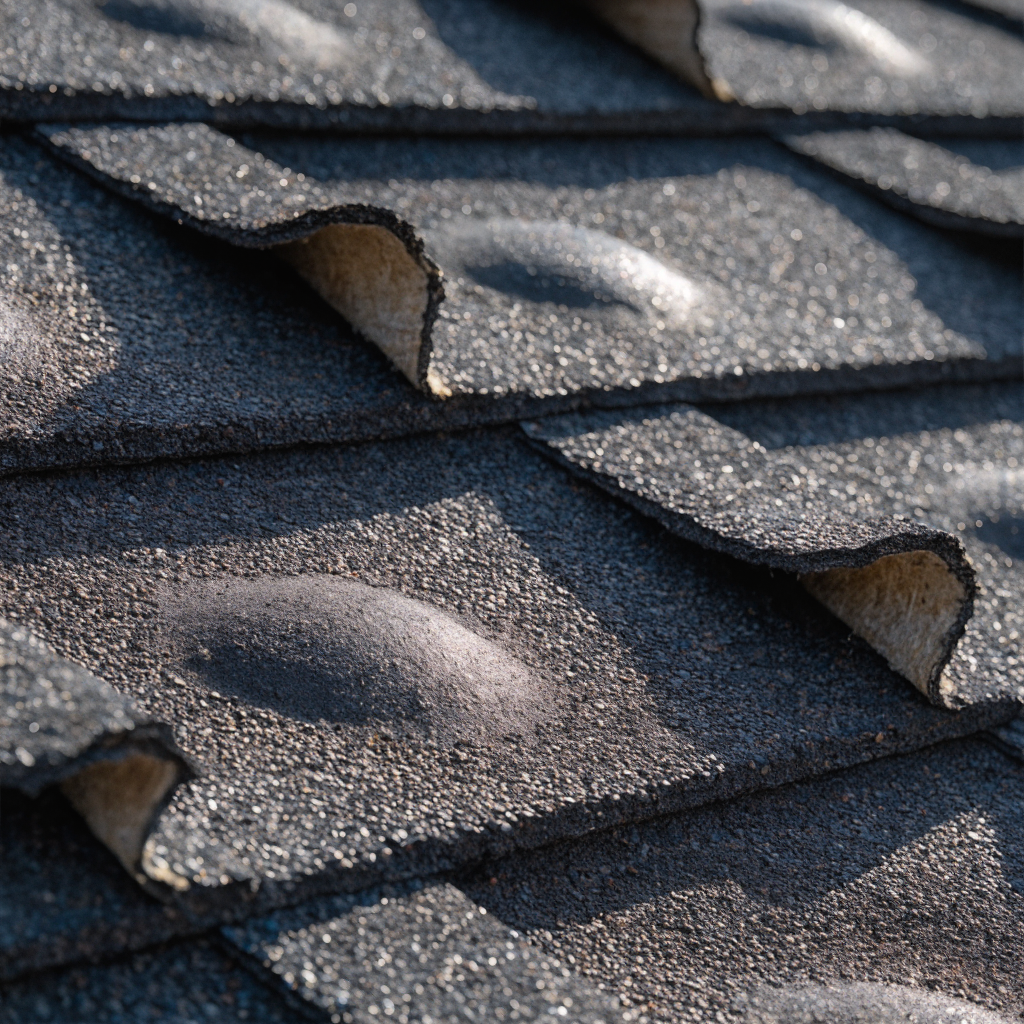
Not every raised spot on an asphalt roof means the same thing. A curling vs blistering shingles assessment distinguishes edges that have turned upward from bubbles forming within the shingle surface. That distinction matters because age, heat, moisture, fastening, and impact can produce different patterns and call for different work.
Recognize curling at the edges
Curling usually shows at corners or along the lower edge of a shingle. Age, repeated heat cycles, moisture, fastening, or an older layered roof can contribute. The pattern across the slope matters more than one isolated tab.
Recognize blisters in the shingle surface
Blisters look like raised bubbles or pockmarks within the shingle. Some remain closed; others break and expose the mat. They can be confused with impact damage, so close inspection and context are important.
Look beyond the surface
Attic heat, restricted ventilation, deck condition, and roof colour can influence how a roof ages. Replacing a few visible shingles without checking the assembly may leave the main stress unchanged.
Choose repair only when it is proportionate
A localized defect on a younger, compatible roof may justify a limited repair. Widespread deformation, brittle tabs, repeated leakage, or unavailable matching shingles may make replacement the more practical choice.
Use distribution and brittleness to set the repair limit
A single curled tab on a flexible, younger field may be replaceable. The same shape across several slopes, combined with cracking when tabs are lifted, changes the economics and the likelihood of a clean repair. Blisters also need context: closed surface bumps are different from open areas where the protective granules and asphalt have broken away. Ask the inspector to explain how the proposed repair will be integrated without damaging adjacent shingles. If matching material is unavailable, an obvious patch may still stop water, but the appearance and limited remaining life should be acknowledged before authorization.
GTA conditions for this roof
Across the GTA, a south-facing roof can bake in summer while a shaded north slope stays damp and cool. Repeated winter temperature swings add another stress, especially on older layered roofs. Compare several elevations and attic conditions; one sunny photograph cannot explain how the full roof has aged.
Map curling vs blistering shingles before choosing work
Have the contractor mark which slopes show edge curl, closed blisters, open blisters, granule loss, or brittle tabs. The review should also record roof age, ventilation observations, previous layers, and whether matching products remain available. Ask how much sound material surrounds each defect and how long a localized repair is expected to last. Those facts make it possible to compare a small repair with replacement timing without treating appearance alone as proof of failure.
Practical planning checklist
- Map where the pattern appears on each roof slope.
- Check the attic for heat and moisture clues.
- Ask whether matching replacement shingles are available.
- Compare a repair life estimate with replacement timing.
The takeaway
The shape of the defect points to the investigation, not automatically to a new roof. Once the pattern, roof age, and attic conditions are documented, the scope becomes easier to defend. MLB Roofing can inspect uneven shingles on GTA properties and explain whether the evidence supports monitoring, selective repair, or a broader replacement plan.
